Monday, 29 July 2013

Sympathy for the tobacco industry


My favourite is sunbed bloke whereas Mr Throat with the manky ‘tache gives me the heebies. I’m talking about the pics on the side of tobacco products of course, which are to continue to co-exist alongside product specific branding after the ConDems backtracked on introducing plain fag packets. 

Now would plain packaging discourage more young people from smoking? No idea, probably I guess, which would be a good thing. More concretely, generic packaging would limit the scope for smokers new and old to develop or maintain any brand loyalty with this undermining the price premium branded products currently enjoy. I reckon this is the real reason fag companies oppose plain packaging.

To give a practical examples, there have always been what were known as “pleb” fags. When I was a teenager it was Kensitas Club, a brand whole families smoked so they could collect the coupons and exchange them for goods at the Kensitas Club shop off Sauchihall street. Hence, smoking Club, fags being a visible thing in social situations, was a marker of (limited) social status.

Latterly, Lambert and Butler took the pleb fag crown because they were a chunk cheaper. No idea what it is now, but I do know 10 Marlboro lights remains the lower to middle middle class Friday night fag of choice. In fact, Marlboro light are the iPhone of fags, both because of who smokes ‘em and because they’re also premium priced. And crikey, having just had a look, branding matters given the 60p difference between the cost of 20 Lambert and Butler King Size vs 20 Marlboro (a 7.5% difference).

Now, put all fags in plain packaging, stand outside a pub, take ‘em out, crash a few even, it doesn’t matter because no one looking at you would be any the wiser as to what brand you were smoking, meaning one of the main reasons for paying extra would disappear in a puff of smoke.

Back to the premium pricing though and the recent legislation forcing supermarkets to sell fags from secret cabinets; thinking about it, these could well become one of the best friends tobacco companies have ever had. Before, when fags and how much they cost were on display, the consumer could compare/contrast prices while standing in the queue. On reaching the till he or she could then choose on the basis of both price and brand. Now, no one has a scooby how much cheaper/expensive the alternatives are. By taking this vital price information off the shelf, the government has made it easier for tobacco companies to charge and maintain a premium of almost £2 in some cases on 20 fags (and retailers who can add a cheeky few pence on and you'll be none the wiser) (1).

Oh and hiding something just out of reach behind a wee, secret door doesn't attract the interest of children? Seriously?


 (1) Combining generic packaging with readily available price lists ordered from most expensive to cheapest per fag or per gramme i.e. to avoid fag companies mucking about with packet size to obscure things, strikes me, a rollie smoker, as the way forward.





Sunday, 14 July 2013

The earth is flat and other fiscal fairy tales


Pesky facts and actual experience having comprehensively destroyed the supposedly practical arguments once presented in support of fiscal austerity, the question now is why are they still at it. The answer, scanning thru George Osborne’s recent mansion house speech, is simple; dogma.

So why are we having to endure “a tough, credible fiscal policy that bears down on our excessive deficit”?  Previously, it was to preserve Britain’s AAA credit rating, the notion fiscal austerity promoted growth and the Rogoff and Reinhart claim that beyond a certain level government debt undermined economic growth. Oh and there was probably scope for runaway inflation too. Now that each these notions has turned out to be utter pants, Osborne says its because we have “a public sector that was too big, paid for by a private sector that was too small” and that “(t)here are more difficult decisions. There have to be when the country is living way beyond its means.”

So there you are then. Why are libraries closing? The public sector’s too big. Benefits being cut? Again, because the public sector is too big. Roads a pot-holed mess? The country was living beyond its means.

Obvious really, except this is moralising tosh that only merits attention because of who is trotting it out given (a) the long-term damage to Britain’s productive capacity fiscal policy continues to wreak (as per the recent growth in long-term unemployment), (b) the strong negative correlation - pointing to causation - between fiscal austerity and economic growth and (c) as examples of rank rotten nasty dogma.

As ever, big dods of Keynes are needed here. One, because, as he observed, an increase in debt funded public sector spending on infrastructure is needed to take up the slack left by a cautious private sector and two because, in place of dogma, as he wryly observed, "When the facts change, I change my mind. What do you do, sir?

Wednesday, 26 June 2013

Arthur Scargill vs the 1%


Many are the reasons for thinking Arthur Scargill is a dick. Mine is how his tactics during the miners' strike made clear he failed to take his political theories seriously – if there is a working class and it is engaged in class struggle with an oppressive ruling class, then you work on the basis said ruling class ain’t going to roll on its back for a tickle when you ask for more (and dear lord they didn’t).

That was then. The credit crunch and subsequent run of banking scandals have made clear we are still ruled by a ruling class and that our society, polity and economy are structured in ways that favour them over us. Like seriously, it;s as blatant as toffs in top hats exercising droit seigneur in the town square.

Obviously, I’m a paranoid, leftie trot. Obviously. Except then you compare/contrast how the state treated the fuck nuggets who took part in the shopping riots with that of the people who caused the credit crunch in Britain, bent the interest rates (and potentially loads of other price indices) used to price gazillions worth of lending and assets globally, facilitated Mexican drug cartel money laundering, missold financial products on an industrial scale and so on and so on.

So on the one hand, the fuck nuggets were rounded up pronto and rushed thru all night courts that dished out exemplary sentances left, right and centre e.g. the two Dundee teenagers who were arrested in August, and given 3 years in December for trying to organise a riot on Facebook that didn’t actually take place.

By contrast, years after the event, one bloke has just been charged here with offences of conspiracy to defraud years after the actual event. One. Am guessing one reason for the delay here was that the SFO and FSA (as was) tried to debate whether what was very obviously a criminal offence was actually a criminal offence (it was, there shouldn’t have been any debate).

As for causing the credit crunch in Britain, industrialised misselling and so forth? Well, 2 blerks are no longer knights and have given up a bit of the huge pensions they’re already getting paid at an age an increasing majority of people can only dream of retiring at. At the same time loads of the other execs who got paid shed loads to do all this have moved on to the hardship that is sitting on the board of companies smaller than the ones they ran into the ground or else early retired to a Portugese golf course. As for money laundering, well the CEO at the time became a government minister. That'll teach 'em.

You’re right you really couldn’t make it up. And yet, despite all of that, fiscal austerity and all of the associated and vile strivers vs skivers bile appears to have genuinely popular political support i.e. some poor sod who hasn’t been able to get a job for over a year is apparently the real cause of Britain’s current economic malaise. And the disabled, especially the disabled.

Sociologically, for me, this provides a useful perspective on Mike Savage’s Great British Class Survey. He says there’s 7 classes? I say arse. There’s a single, coherent, ruling class that occassionally takes in the most ambitious and capable plebs (but only ever on an individual basis) and then there’s everybody else. Really, all the schemata presented in the Class Survey proves is that beneath the ruling class lies an incoherent, sky-plus numbed mass that can be randomly sliced and diced into whatever categories you want because they’re no more meaningful, conscious or aligned than the kind of dreck marketing firms spew out at regular intervals; they’re certainly not the kind of classes Arthur Scargill failed to recognise.

All bets are off


A mate txted me yesterday morning and told me to look up the Anglo Irish chat. The revelations certainly made for good “craic”, but apart from that so what? When I read an enquiry had been proposed as the official response, I tried to organise a bet that, apart from a 3 hour or so grilling by politicians in however many months time, both would get off Scot free. That was at 10.19. By 11.01 all bets were off.

I don’t bet, however, this seemed/ still seems a sure thing. Unfortunately, my mate shared my view that too many Orish politicians are implicated for anything even approaching justice to be served. Implicated in what you ask? Well, dat’d be the events leading up to then took place during the orish banking crisis. To be sure.

Like go here, here and here, fer instance, to read the chat and it actually leaves you feeling kinda dirty. Tax dodgers aside, the Orish economy reads like it was dominated by a charmed circle of politicians, bankers and businessmen/property developers who vigoursly backhanded the entire economy into the ground; did you hear O’Flaherty wants to develop dat dere land? Well, to get approval he’ll have to give the minister a helicopter ride to the races, bung his wife Eur50,000, do it as a joint venture with O'shaughnessy and make sure the bank executive is happy wit it’all. To be sure. And what did the regulator say? Daft Michael? Aww, we’ll just leave him out of it, besides you know how his head of section is pals with those senior banking fellas.

That was before things went tits up. Since then the entire economy has been unnecessarily put on the line by the government deciding to guarantee all bank deposits followed by a never ending run of bank bailouts, then the initial attempt to get taxpayers to overpay for bad bank assets via NAMA.

Anyone who seriously tried to bring any part of that to justice runs the risk of formally exposing the whole damn shebang. On the basis turkeys don’t vote for Christmas, the only thing I reckon any enquiry, give or take some recommendations about what not to do in future, will do will be to stall, delay and prevaricate until things have moved on.

So any takers for my bet (I’d gladly be wrong)?


P.S. Yes events in Ireland do put what happened here into sharp relief including the limitations of British journalism given its complete failure to place it in its proper context. As for the facetious /cack orishisms above, a system that bent doesn’t deserve respect.

Saturday, 8 June 2013

Fiscal austerity vs the life-cycle


Ohmigawd public sector debt! Ohmigawd! Pay it back or else, or else …… no much really.

The pro-austerity lot are funny about this because the way they approach it is so at a remove from well life really, including the businesses they love smearing themselves over.

Over the life-cycle, your own debt experience is ideally shaped like a bell curve. Simplistically, as you age you acquire more debt, say to pay for being a student, then to buy a car, then even more to buy a house. Time passes, grey hairs appear and the debt gradually reduces as you pay it back. And then you die.

When you adopt this perspective and apply it to government like a Maggie Thatcher, fer instance, then of course the deficit needs reducing and no wonder bods on the right talk about public sector debt as a destructive legacy that will harm future generations. Except “you” as a unit of analysis is pants. Government is a collective entity and does not have a finite lifespan, fundamental differences that really matter.  

So rather than “you” think of the collective entity you’re most intimately involved in, which is your family, over the same life-cycle; at a family level, as you’re repaying your debt there’s a good chance your kids are beginning to acquire it; on a net basis families continually carry debt because different members – particularly Uncle Nigel -  are simultaneously borrowing and repaying cash.

Even then, I don’t think the family is a sophisticated enough metaphor to use to understand government debt. Big corporations are and they have all sorts of debt. They borrow from banks, they issue bonds, they take shareholder cash via ordinary and preference shares, all to find the most financially efficient capital structure. The price of debt falls? Companies borrow more. Rises? They borrow less, but regardless of the specific amounts, company debt is never ending. And to add a touch of reality here, if a company had no debt whatsoever, chances are a private equity bod would snap it up so he could load it up with some.

Is it possible to have too much debt? You betcha cos there’s refinance risk and exposure to future interest rate movements. But, those are things to manage not avoid. Besides, too much of anything is bad for you.

However, the notion that government debt must be repaid NOW is stupid. It’s not how families work nor is it how terribly sophisticated companies complete with treasury departments work either. You might think that it does, but then that’s just you.

Right now, government is uniquely well placed to borrow at historically low interest rates to finance the kind of investment that would lessen the impact the credit crunch is having on innocent individuals and their families.Doing so would be morally right and would also lessen the damage fiscal austerity is doing to Britain's long-term economic prospects by destroying its productive capacity.

Arguments for Scottish independence part 3: Assets and practicalities


Picking thru the requirements of what an independent nation needs, Scotland is already very well placed thanks to devolution and stuff left over from the 18th century

Here’s a brief list:

Legal system? Check.
Education system? Check (schools, universities and professional associations fer goodness sake)
Multi-party democracy? Check (plus independence would remove a tier)
National health service? Check

And so on and so on. Really, the existing infrastructure is so well developed and already sufficiently autonomous  as to render many of the practical arguments against independence redundant. Hence, much of the pro-union chat focuses on the softer benefits of the union, like how we’re better together just because we are really, and how being in the union meant Scottish people got to wear British swimming trunks at the olympics. Now that’s all lovely I guess, except the union also means being part of an electorate that voted in the ConDems and appears to support punishing the disabled.  

However, that’s another post. Getting back to the practical issues, there is one, glaringly big exception, which is the financial system and the economy more generally. This is accordingly where the more practical opposition to independence is going to town. Its also a big-big-biggie given the credit crunch and Scotland’s unfortunately disproportionate contribution to the British experience.

Except, the pro-union mentality on display really needs to get a grip. Following on from the HM Treasury propaganda, this blerk here has produced a less biased, more constructive analysis of “Scotland's currency options”. But, even then he just can’t resist the cute point scoring. Like when he talks about currency boards and describes the Irish experience as follows “Ireland chose to fix its exchange rates at parity when leaving sterling. The Irish central bank then spent the next fifty or so years defending the exchange rate until joining the ERM”, he forgot to mention sterling had a fixed exchange rate for much of the same period that HM Treasury also spent years defending i.e. the actual point here isn’t currency pegs are somehow intrinsically a bad thing, rather its what was ultimately a fixed exchange rates proved a serious constraint (by contrast a Sterling currency peg right now would be to a floating currency).

However, its when he says (in the 3rd paragraph) “An independent Scotland would have to move swiftly to create the necessary institutions and capital markets. This would include a central bank, a payments system, deposit insurance, prudential and conduct financial regulators, a debt management office, an exchequer, a tax collection agency, a fiscal commission, equity and capital markets and, of course, a currency mint.” I’m left thinking cool the beans there a minute bawjawz, cool the beans.

This is because of how he chooses to discuss an independent Scotland’s assets and liabilities. In liability terms, its about how Scotland would need to take its fair share of UK national debt with it. Now, this is an important point to make, however, the discussion of Scottish assets is less good, because it focuses almost exclusively on oil.

Actually, though, Scottish assets also include Scotland’s share of UK level institutions, you know the ones Scottish taxpayers have paid into and been governed by. As with the divvying up of the national debt – incurred partly to finance the creation and running of said institutions – giving us a bit of them would only be fair.

To give a practical example drawn from bawjawz’s willfully intimidating shopping list, establishing “prudential and conduct financial regulators” – fine, we’ll have a copy of the PRA (was FSA) rule book we helped pay for please, some 12 month secondees to the existing Edinburgh office and we’ll advertise for new staff on Monday. And yes the job adverts will big up how existing PRA staff can transfer their existing skills to a city with more affordable housing and a better commute than London.

Oh and not having such a complex financial system as London to regulate means it could well be cheaper and potentially safer to do so here given there’s only the one Scottish bank with serious, but shrinking investment bank capabilities as opposed to the teaming hordes scattered across London. Bonus! (and another example of the positioning issues affecting the pro-union lot; they, rightly, say an independent Scotland would have a disproportionately large exposure to the financial services sector, but it would also be at a remove from so-called “casino” banking e.g. a Glasgow insurance company call centre poses less systemic risk to the Scottish economy than Mayfair's hedge fund bods do to the UK. And, they probably pay more tax!).

As for some of the other stuff on the list, well bawjawz is just being silly. Take “and, of course, a currency mint”; really? Again with the memory lapse given the EXISTING Scottish note issue and the fact the Royal Mint already makes coins to order for foreign countries.

Personally, I’m increasingly left wondering why the pro-union lot is placing sooooo much emphasis on the scare tactics even when it involves making basic factual errors. In the meantime, when you run thru the assets and infrastructure Scotland already has, from a practical perspective independence doesn't strike me as an especially daunting prospect. Saying that, the 2014 Commonwealth games mascot is an embarrassment.

Sunday, 26 May 2013

Arguments for Scottish independence part 2: Oil


A thing that bugs me about The Economist is its bias. Like with Hugo Chavez, in what was effectively an obituary they still found time to go on about his recklessness and his “corrupt, oil-fuelled autocracy”, but failed to mention how in amongst the grandstanding, Venezuala has a soveriegn wealth fund worth $800m.

By contrast Scotland and the rest of the UK doesn't have one at all, which makes North Sea oil, so far, an incredible, missed opportunity. Sure, go to Aberdeen and you’ll see more new build executive villas, 4x4s and giant plasma screen tellies than you can shake a stick at. But, these belong to people who – like the UK government – are spending today what won’t, evenetually be there tomorrow.

This uniquely British approach to oil dates back to the 1976 UK financial crisis that saw Britain apply to the IMF for a bail out. In these circumstances the associated rush to bring oil on shore made sense as the new revenues then helped ease immediate and pressing financial problems (the "lax" approach to health and safety this also involved is somewhat less justifiable, but does strenghten the moral case for regarding North Sea oil as a distinctively Scottish asset). Over time the UK government’s fixation with spending every penny oil generated as soon as it could became less justifiable, something that made North Sea oil forward production curves increasingly handy.  

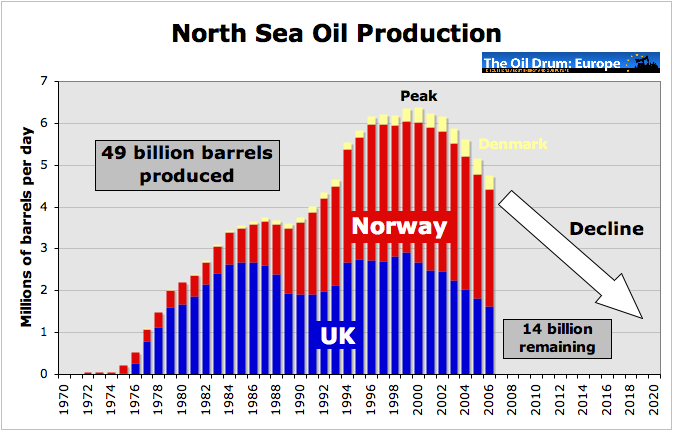
I’ve seen loads of these production forecasts over the years, so many I just pulled the one presented above randomly off the internet without bothering to check when it was produced. This is because each one tells the same story; North Sea oil production has peaked, it’s now in decline and within a couple of decades it’ll all be gone. Given this (1) why bother setting up a soveriegn wealth fund and (2) Scotland had better stay in the union because when the oil runs out we’ll be fecked.

Except, every year when the production curves get refreshed they push the end date out another few years. The reasons why are straightforward. Well when I say reasons, I mean reason. So sure sure, technological advances are a factor, but really it’s about price. As North Sea oil is relatively expensive to produce, North sea oil production has a relatively high hurdle rate i.e. the price below which its not worth bothering about. Hence, every production curve is actually a forecast of how much oil it will be economic to produce, not how much is left. As prices rise more oil becomes economic to produce and the production curve shifts that bit further to the right. Globally, the most obvious example of this are the Canadian tar sands, which have gone from being well sand really to one of the world’s largest oil reserves.

Now, picking through the historic data what stands out is how in the past supply side shocks have driven oil prices to record highs. Now though its more to do with demand due to global economic development, most obviously Chinese economic growth. And as this isn’t going away any time soon, while oil prices will certainly move about in the future, they remain unlikely to fall back to the levels seen in the 1990s anytime soon.

This in turn means North Sea oil will be with us for a good while yet, which has obvious implications re: the Union. As no UK government has ever shown itself to be the slightest bit willing to view North Sea oil as anything other than an immediate cash cow to be milked as aggresively as possible, staying in the Union means when North Sea oil does eventually run out, the benefits of this once in a (nation’s) lifetime opportunity will already have been frittered away on tax cuts and London based legacy projects. Plus, the Scottish post-industrial experience suggests Aberdeenshire’s post-oil experience will not be pretty.

Given this independence is the only option if we want to establish a permanent, positive North Sea oil legacy. Leaving the union and establishing a Scottish soveriegn wealth fund will also address the volatility issue raised by the UK treasury in its scaremongering tosh about Scottish independence – in good years more money gets paid in, in bad years less. There. Sorted. Easy.

To put this another way, I’d rather North Sea oil revenues eventually funded the university I hope my grandchildren attend than had been pissed away putting up the millenium dome.