Showing posts with label Scottish independence. Show all posts

Monday, 17 March 2014

Scottish independence vs Devo-max


I reckon there are at least two big problems with Devo-max or the devolution of more powers as an option. One, the shower of shite sat in Holyrood and two, it would leave the chip on the Scottish shoulder firmly in place.

Re: One – Devo-max would simply give more power to the existing MSPs. There would be no gradual transformation of Scottish politics wherein Holyrood became an end in itself as opposed to the ex-councillors' gravy train it currently is. Plus, the ongoing tension between what UK level political parties want and what their Scottish offshoots do would remain. To be fair this second point is primarily a Labour party issue given what the Tories do here is largely irrelevant as are the Greens and as for the SNP, well the clue’s in the title.

Re: Two – Devo-max would leave the blame England mentality in place, something both supporters and opponents of devolution have been known to buy into like perpetual adolescents.

The two problems are inextricably inter-linked; the key issues for a devolved government are getting and spending, by which I mean periodically negotiating (UK) central government funding levels, then apportioning said monies out across the various devolved areas of responsibilities.

And just as every council blames central government funding cuts whenever it cuts services, so a devolved Scottish parliament can blame Westminster when it fails to get what it wants out of negotiations or just for the heck of it.

What a devolved Scottish politics, as with any adolescent, doesn’t do is take full responsibility for the consequences of its actions. Remember, Holyrood already had the power to vary income tax, just not the self-confidence or political will to do so.

Wednesday, 12 February 2014

The nuclear option


So George Osborne, sources are letting it be known, will rule out the notion of a formal currency union with an independent Scotland? Interesting negotiating position if you're an utter walloper (1).

In that case, when Scotland hopefully votes yes to independence, the Scottish approach to relocating the Rest of the UK's nuclear bombs will presumably be; your problem pal, pick 'em up next Tuesday and F'right off in the meantime. Or not.

Actually negotiating both points would very obviously be the right, nice, sensible, intelligent and decent thing to do. Or is that asking too much of a Bullingdon Club Tory?


(1) interesting reading English people commenting on this and how its all about Scotland wanting its cake and eating it. Even if it was, and? Jealous? And that's besides the obvious benefits a currency union would also give to English businesses that trade with Scotland - or is the approach here one of sour grapes mixed with cutting 10% of your nose off to spite your face?

Thursday, 6 February 2014

The real arguments against Scottish independence


“They” haven’t been telling you what the real arguments are against Scottish independence. “They” have been keeping quiet about them, not wanting you to know. Well there’s no omerta here, not on this blog,  no sir-ee*.

So here they are, these are the real deal, raw and uncut reasons why”they” won’t vote for Scottish independence:

1)      Can’t be arsed
2)      Anyway, have you no seen that shower up in Holyrood?
3)      Besides, see that Alex Salmond, I don’t trust him

And now they’re out in the open, its easy to point out why each one is largely pants.

Take (1), which cuts both ways. Looking over Hadrian’s wall does anyone actually think the UK civil service, politicians or what have you can actually be arsed with all the logistics and negotiations Scottish independence would entail? Like take the nuclear bombs currently stored in Scotland, do you actually think anyone in England can be arsed with storing them given all the construction, protests, planning permission disputes and what no doing so would generate? No me neither and that’s before you’ve started talking about the easy stuff like who get’s what embassy (bagsie Paris for Scotland). Except, from a Scottish perspective this isn't a reason to vote no.

(1) also applies this side of Hadrian’s wall and can be approached via a hypothetical conversation between a dad and his son: “So dad, why did you vote against Scottish independence (assuming you even bothered to vote), why did you commit me to however many more years of masochistic austerity measures used to pay for tax cuts for the rich, why did you want me to live in a Britain where Daily Mail headlines influence education policy, UKIP immigration policy and London & the S. East pretty much everything else government does?” Well son, it’s because I couldn’t be arsed”.

      Re: 2) you’ll get no argument here that that shower up in Holyrood is anything, but a shower. But,
          staying  in the Union won’t change that whereas leaving it will if only because cutting the Westminster  
          escape route will, at the very least, force our existing politicians to compete harder for fewer seats.

3)    I don’t get the down on Alex Salmond being too vain and sleekit personally, I mean Idi Amin is already the King of Scotland, whereas Alex Salmond is just a politician and politicians say what they think the electorate wants to hear. But, anyhoo, as the Labour Party in Scotland’s gradual decline into opposition makes clear, the story of devolution is also the story of how the Scottish electorate can’t be taken for granted; if Alex really is such a bam, then chances are he’ll lose/get turfed out via the wonders of democracy.


* Making these arguments a serious part of the mainstream debate would risk highlighting the apathetic and ignorant nature of much of the electorate, the utter mediocrity of Scottish political life and an associated fixation with the personal that’s trivial even by Nick Robinson standards.

Wednesday, 5 February 2014

A UK North Sea Oil sovereign wealth fund and other fairy tales


As long as Scotland remains a part of the UK, there will never be a Scottish let alone a British North Sea Oil funded sovereign wealth fund. The reasons why are almost entirely political.

To set up a fund now would undermine the notion Scotland benefits financially from being part of the UK especially the more vicious form of this argument that claims England subsidises public spending in Scotland. Setting up a fund now would also prompt questions about why wasn’t it done sooner like in 1990 when Norway set up what’s now the largest fund in the world. More than this it would call into question the credibility and policies of previous governments, Labour and Tory (but particularly the 1980s Tories i.e. Thatcher). Finally, a fund would have too much symbolic meaning; it would be a powerful Scottish nationalist (and Nationalist) totem and a recurring reminder that for quite some time now no Scotland very clearly hasn't been "better together".

So we won’t get one (and neither will the UK). Instead, without Scottish independence, today’s revenues will continue getting spent today, there’ll be no north sea oil funded investment in Britain and no meaningful legacy for future generations.

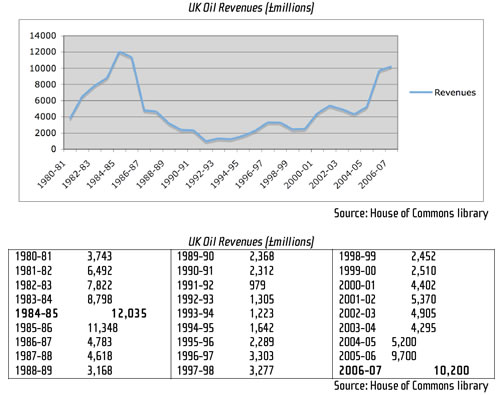
Instead, the best we’ll get is yet another “expert” being trotted out to claim (yet again) that future production and revenues are in secular decline (other than when they aren't - see graph/numbers above, recent headlines about record investment in the North Sea by super majors etc.,), so it just isn't worth the candle (well if its so unimportant, there'd be no harm setting one up then).

Wednesday, 29 January 2014

Is the case for Scottish independence in tatters?


Mark Carney’s Scottish speech is too measured a thing for commentators not to aggressively spray it with a mixture of twaddle and tosh in a manner largely reliant on implausible strawmen.

Take the notion of control and how a post-independence Scotland that entered a currency union with the Rest of the UK (rUK) would have no control over its exchange rate. Except, all this means is an independent Scotland wouldn’t gain something it currently doesn't have i.e. there would be no change. Hence, when Robert Peston trots out the following twaddle “Now the value of the pound would tend to reflect economic conditions in the larger economic area of England, Wales and Northern Ireland, not the more recessionary conditions in Scotland. So the pound would not fall to offset the downturn in Scotland and give a boost to the export prospects of Scottish companies”, he is ignoring the fact this is already the case.  

As for tosh, Robert Peston then goes on, in a Treasury paper type styley, to say that “the economies of Scotland and that of RUK would diverge”, this being, it would appear, a terribly bad thing because a Rest of the UK set monetary policy might not suit Scotland.

Except, again this is already the case and besides here’s what Mark Carney actually said about divergence: “Surprisingly, a review of major currency areas suggests that similarity is neither necessary nor sufficient for success. For example, the industrial structures of the core and periphery of the euro area are more similar than those of the constituents of Canada or the US (table 1). Yet few  would argue that the euro area is the most effective currency union of the three. Conversely, the Canadian monetary union works well despite having substantially larger industrial variation than even the US …..being similar doesn’t necessarily help and being different doesn’t necessarily hinder”.

Mark Carney then says there would also be a need for a banking union, which would entail:

1)      Common supervisory standards,
2)      Access to central bank liquidity and lender of last resort facilities,
3)      Common resolution mechanisms, and
4)      A credible deposit guarantee scheme

Now, this is the ideal type scenario, the EU not having all of the above, but anyhoo, lets take each in turn:

1)     Fine, give us a copy of the rule book we’ve already part paid for and that financial institutions already adhere to, sometimes (and because a Scottish financial system would be much simpler e.g. no hedge funds or investment banks, it would also be cheaper to supervise)
2)     Hmm, this is a bit trickier
3)     Nae bother, we’ll get a copy of the rule book when its finally agreed (there isn’t really one at the moment) and/or introduce the necessary laws into the Scottish parliament using the UK precedent.
4)     You mean like the one all the foreign banks already operating in London already have? Oh go on then.

Suddenly independence isn’t an especially daunting prospect anymore and that’s before we get to the meat of the issue and the prize; fiscal policy or to quote Mark Carney “there is an obvious tension between using robust fiscal rules to solve this problem, and allowing national fiscal policy to act as a shock absorber. This reinforces the need for fiscal risk sharing between nations. “

Or to put it another way, an independent Scotland wouldn’t be able to tax and spend exactly how it chose, be that recklessly or not. Except we knew that already and anyway, even if Scotland had an independent currency, the bond markets and rating agencies would make clear what appropriate government debt levels and spending levels would be.

However, even if total government spending could only vary incrementally from the rUK, there is obvious scope for what the total gets spent on to vary significantly, which actually matters a lot.

Two quick examples: First, transport and infrastructure – Right now, Crossrail is Europe’s biggest construction project. At a cost of c.£16bn it will make it easier to commute across London. When Crossrail is finished it looks like the biggest construction project will be HS2, which will make it easier to commute into London. Before Crossrail, the Chunnel was probably the biggest construction project, which made it easier to travel from Paris to - wait for it, wait for it - London. Then there’s the possibility of another Heathrow runway, which would make it easier to travel into London from well anywhere really i..e. an independent Scotland would be able to spend the same amount of money it currently contributes to rUK infrastructure spending, but on things other than the long-term UK commitment to massively subsidising London commuters, like have you seen the state of the roads round Aberdeen, howzabout finally reinstating the Waverly line or having a dual carriageway all the way through the borders?

Second, military spending and foreign policy; in one of his pro-Union speeches Alastair Darling highlighted the phallic size of the British military budget as if spending all that money on being able to kill people was a good thing. Except, whereas Britain had the 4th largest military budget in the world in 2013 and spent a bigger share of its GDP on it than Japan, France, Italy and Germany, the British economy was only the 7th largest. So here’s a mad proposal, an independent Scotland could pay itself a peace dividend by cutting military spending back to a level either in line with its economy or less than. Then, it took the money saved and spent it on mad shit like social housing, education, care for the elderly, economic development and so on without breaching any overall fiscal rules (and not invading anymore countries at the behest of the US).

So does Mark Carney’s speech leave the case for independence in tatters? No it fucking well does not.   

Wednesday, 18 September 2013

Yet more anti-independence bollocks masquerading as journalism


In honour of James Naughtie badgering Nicola Sturgeon on the Today programme this morning re: something Alex Salmond said in 1999 (!) about the pound and Scottish  independence, lets pick out yet another tiresome example of anti-independence bias and show it up for the utter bollocks it actually is.

This time it’s the (Glasgow) Herald with its recent article headlined “Lloyds could move HQ post-independence”. !!!!!!! Oh no, disaster, loads of jobs might be lost if Scotland voted yes!!!!!

Except, Lloyds Banking Group isn’t headquartered in Scotland. Its company website clearly states its head office is on Gresham Street in the City of London. Its registered office is in Scotland right enough, which is what the CEO was specifically referring to in the interview the Herald derived its completely makey-uppy bollocks from, but – as any accountant will happily explain – where a company is based and where its registered are two very different things. 

So the (Glasgow) Herald article set out a threat, engaged in fear-mongering even, on the basis of a potential something that was just flat-out bullshite.

There’s  two ways of explaining this, 1) the (Glasgow) Herald business journalists know jackshit and/or 2) they or the editor is that rank rotten biased against independence, they’re willing to trot out any made up shite to support the party line. Either way they clearly aren't credible.

But, who didn’t know that already? Besides, the bulk of today’s independence chat was flannel and noise, which served only to distract from the National Institute of Economic and Social Research’s finding that if you divvied out the UK national debt post-independence, it would equal 86% of national income in Scotland vs 101% for the rest of the UK. 

And to be clear the blerk who reached this conclusion is not pro-Scottish independence given an earlier article wot he wrote  started off with post-communist Russia (I shit you not) as a wholly inappropriate and fear-mongering reference point for what an independent Scotland might be/have to contend with.

And this debt number is very, VERY important. Up until now, the national debt has been used as yet another scare tactic by terribly serious anti-independence people. The argument here has been as follows - yes well, independence doesn't just mean keeping the oil to ourselves don't you know, we'd have to take on our fair share of UK liabilities as well, oh yes. 

Except, now, when you deliberately stop quoting totals and start looking at percentages, it turns out that would be a good thing, a very good thing. Really, there are two stories here. One, it turns out Scottish independence does more to reduce public debt than any amount of taxes on the disabled, impliying independence would generate mucho financial benefits for all concerned north of Carlisle. And two, the Scottish broadsheets and London meja are shit scared of basic facts getting out.

Actually there’s a third. Personally, I was mad impressed with Alastair Darling during the more intense stages of the credit crunch. Now, with his anti-independence chat he comes across as being about as credible and insightful as Johann lamont’s left bollock with all the dignity of a badger that's just shat itself. What happened to him?

Saturday, 8 June 2013

Arguments for Scottish independence part 3: Assets and practicalities


Picking thru the requirements of what an independent nation needs, Scotland is already very well placed thanks to devolution and stuff left over from the 18th century

Here’s a brief list:

Legal system? Check.
Education system? Check (schools, universities and professional associations fer goodness sake)
Multi-party democracy? Check (plus independence would remove a tier)
National health service? Check

And so on and so on. Really, the existing infrastructure is so well developed and already sufficiently autonomous  as to render many of the practical arguments against independence redundant. Hence, much of the pro-union chat focuses on the softer benefits of the union, like how we’re better together just because we are really, and how being in the union meant Scottish people got to wear British swimming trunks at the olympics. Now that’s all lovely I guess, except the union also means being part of an electorate that voted in the ConDems and appears to support punishing the disabled.  

However, that’s another post. Getting back to the practical issues, there is one, glaringly big exception, which is the financial system and the economy more generally. This is accordingly where the more practical opposition to independence is going to town. Its also a big-big-biggie given the credit crunch and Scotland’s unfortunately disproportionate contribution to the British experience.

Except, the pro-union mentality on display really needs to get a grip. Following on from the HM Treasury propaganda, this blerk here has produced a less biased, more constructive analysis of “Scotland's currency options”. But, even then he just can’t resist the cute point scoring. Like when he talks about currency boards and describes the Irish experience as follows “Ireland chose to fix its exchange rates at parity when leaving sterling. The Irish central bank then spent the next fifty or so years defending the exchange rate until joining the ERM”, he forgot to mention sterling had a fixed exchange rate for much of the same period that HM Treasury also spent years defending i.e. the actual point here isn’t currency pegs are somehow intrinsically a bad thing, rather its what was ultimately a fixed exchange rates proved a serious constraint (by contrast a Sterling currency peg right now would be to a floating currency).

However, its when he says (in the 3rd paragraph) “An independent Scotland would have to move swiftly to create the necessary institutions and capital markets. This would include a central bank, a payments system, deposit insurance, prudential and conduct financial regulators, a debt management office, an exchequer, a tax collection agency, a fiscal commission, equity and capital markets and, of course, a currency mint.” I’m left thinking cool the beans there a minute bawjawz, cool the beans.

This is because of how he chooses to discuss an independent Scotland’s assets and liabilities. In liability terms, its about how Scotland would need to take its fair share of UK national debt with it. Now, this is an important point to make, however, the discussion of Scottish assets is less good, because it focuses almost exclusively on oil.

Actually, though, Scottish assets also include Scotland’s share of UK level institutions, you know the ones Scottish taxpayers have paid into and been governed by. As with the divvying up of the national debt – incurred partly to finance the creation and running of said institutions – giving us a bit of them would only be fair.

To give a practical example drawn from bawjawz’s willfully intimidating shopping list, establishing “prudential and conduct financial regulators” – fine, we’ll have a copy of the PRA (was FSA) rule book we helped pay for please, some 12 month secondees to the existing Edinburgh office and we’ll advertise for new staff on Monday. And yes the job adverts will big up how existing PRA staff can transfer their existing skills to a city with more affordable housing and a better commute than London.

Oh and not having such a complex financial system as London to regulate means it could well be cheaper and potentially safer to do so here given there’s only the one Scottish bank with serious, but shrinking investment bank capabilities as opposed to the teaming hordes scattered across London. Bonus! (and another example of the positioning issues affecting the pro-union lot; they, rightly, say an independent Scotland would have a disproportionately large exposure to the financial services sector, but it would also be at a remove from so-called “casino” banking e.g. a Glasgow insurance company call centre poses less systemic risk to the Scottish economy than Mayfair's hedge fund bods do to the UK. And, they probably pay more tax!).

As for some of the other stuff on the list, well bawjawz is just being silly. Take “and, of course, a currency mint”; really? Again with the memory lapse given the EXISTING Scottish note issue and the fact the Royal Mint already makes coins to order for foreign countries.

Personally, I’m increasingly left wondering why the pro-union lot is placing sooooo much emphasis on the scare tactics even when it involves making basic factual errors. In the meantime, when you run thru the assets and infrastructure Scotland already has, from a practical perspective independence doesn't strike me as an especially daunting prospect. Saying that, the 2014 Commonwealth games mascot is an embarrassment.

Sunday, 26 May 2013

Arguments for Scottish independence part 2: Oil


A thing that bugs me about The Economist is its bias. Like with Hugo Chavez, in what was effectively an obituary they still found time to go on about his recklessness and his “corrupt, oil-fuelled autocracy”, but failed to mention how in amongst the grandstanding, Venezuala has a soveriegn wealth fund worth $800m.

By contrast Scotland and the rest of the UK doesn't have one at all, which makes North Sea oil, so far, an incredible, missed opportunity. Sure, go to Aberdeen and you’ll see more new build executive villas, 4x4s and giant plasma screen tellies than you can shake a stick at. But, these belong to people who – like the UK government – are spending today what won’t, evenetually be there tomorrow.

This uniquely British approach to oil dates back to the 1976 UK financial crisis that saw Britain apply to the IMF for a bail out. In these circumstances the associated rush to bring oil on shore made sense as the new revenues then helped ease immediate and pressing financial problems (the "lax" approach to health and safety this also involved is somewhat less justifiable, but does strenghten the moral case for regarding North Sea oil as a distinctively Scottish asset). Over time the UK government’s fixation with spending every penny oil generated as soon as it could became less justifiable, something that made North Sea oil forward production curves increasingly handy.  

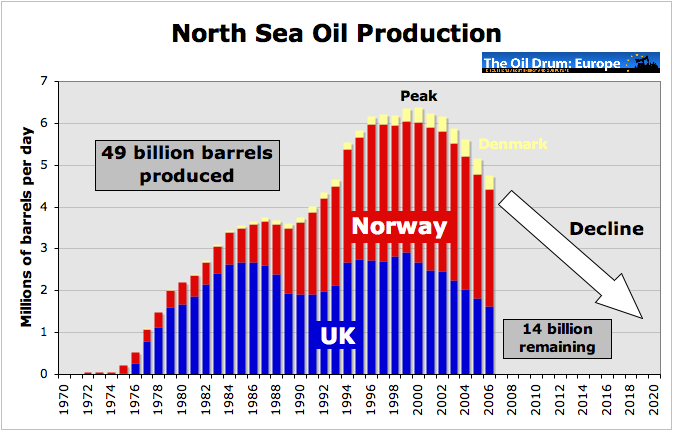
I’ve seen loads of these production forecasts over the years, so many I just pulled the one presented above randomly off the internet without bothering to check when it was produced. This is because each one tells the same story; North Sea oil production has peaked, it’s now in decline and within a couple of decades it’ll all be gone. Given this (1) why bother setting up a soveriegn wealth fund and (2) Scotland had better stay in the union because when the oil runs out we’ll be fecked.

Except, every year when the production curves get refreshed they push the end date out another few years. The reasons why are straightforward. Well when I say reasons, I mean reason. So sure sure, technological advances are a factor, but really it’s about price. As North Sea oil is relatively expensive to produce, North sea oil production has a relatively high hurdle rate i.e. the price below which its not worth bothering about. Hence, every production curve is actually a forecast of how much oil it will be economic to produce, not how much is left. As prices rise more oil becomes economic to produce and the production curve shifts that bit further to the right. Globally, the most obvious example of this are the Canadian tar sands, which have gone from being well sand really to one of the world’s largest oil reserves.

Now, picking through the historic data what stands out is how in the past supply side shocks have driven oil prices to record highs. Now though its more to do with demand due to global economic development, most obviously Chinese economic growth. And as this isn’t going away any time soon, while oil prices will certainly move about in the future, they remain unlikely to fall back to the levels seen in the 1990s anytime soon.

This in turn means North Sea oil will be with us for a good while yet, which has obvious implications re: the Union. As no UK government has ever shown itself to be the slightest bit willing to view North Sea oil as anything other than an immediate cash cow to be milked as aggresively as possible, staying in the Union means when North Sea oil does eventually run out, the benefits of this once in a (nation’s) lifetime opportunity will already have been frittered away on tax cuts and London based legacy projects. Plus, the Scottish post-industrial experience suggests Aberdeenshire’s post-oil experience will not be pretty.

Given this independence is the only option if we want to establish a permanent, positive North Sea oil legacy. Leaving the union and establishing a Scottish soveriegn wealth fund will also address the volatility issue raised by the UK treasury in its scaremongering tosh about Scottish independence – in good years more money gets paid in, in bad years less. There. Sorted. Easy.

To put this another way, I’d rather North Sea oil revenues eventually funded the university I hope my grandchildren attend than had been pissed away putting up the millenium dome.

Thursday, 23 May 2013

New Treasury study proves Scottish independence would kill the Scottish economy


Wow. No seriously, WOW. After the first Treasury paper on currency options for an independent Scotland I knew any other stuff they trotted out would be at least as annoying, but with the “Scotland analysis: Financial services and banking” paper they’ve really outdone themselves.

So lets start with the basics – in the executive summary they say “The Scottish banking sector would be exceptionally large compared to the size of an independent Scotland’s economy, making it more vulnerable to ­financial shocks than it is as part of the larger UK…. Scottish banks have assets totalling around 1254 per cent of an independent Scotland’s GDP”. They continue by noting “The banking sector in an independent Scotland would be dominated by the two largest banks – the Bank of Scotland and the Royal Bank of Scotland (RBS).”

Hmm. Can you spot the deliberate mistake there, can you? No? Here’s a clue – Bank of Scotland (BoS) merged with the Halifax to form HBoS in 2001. This was followed by a campaign to keep the HBoS HQ in Edinburgh, because well it wasn’t really a Scottish bank anymore. Then HBoS was taken over by Lloyds TSB in 2009 and is now a wholly owned subsiduary of the Lloyds Banking Group. There are, I’m sure, various Scottish registered Bank of Scotland related legal entitites, but there is no Bank of Scotland in an especially meaningful sense; other than as a brand, it is dead, it has ceased to exist. 

So yeah, sure RBS and BoS dominate Scottish banking markets, but if Bank of Scotland went phut howz that a Scottish problem? And the assets to GDP ratio is presumably utter tosh as well due to this (?). And and, lets be clear the bulk of “Scottish” bank assets are outside Scotland, like if RBS went phut the day after independence this would be an issue for the rest of the UK as NatWest savers and borrowers shat themselves in a cross-border bank crash lets learn from the Fortis example prompting new legislation/arrangements for managing bank failures kind of thing.

Now mebbe the paper recognises this because it does refer to how much the RBS bail out cost, but not the  HboS related Lloyds one. Or mebbe it doesn’t because then it talks about how “First, if the large bankS (emphasis added) made no changes to their group structure and kept their existing headquarters, an independent Scotland would have an exceptionally large fi­nancial sector”. Err, why the plural? As it’s a wholly owned subsiduary HBoS i.e. BoS is already headquartered in London. Or perhaps its the Clydesdale they’re talking about, except that’s owned by the National Australia Bank headquartered in Australia of course. Handelsbanken is certainly growing its Scottish operations, but again I’m not convinced its especially Scottish.

It’s a shame this isn’t clarified because then the paper talks about how “where large fi­rms are faced with greater concentration or risk they may look to diversify or restructure themselves for example so that they were no longer headquartered in Scotland. If this were to happen it could undermine Scotland’s current status as an important financial centre”. Now, this confused me because other than RBS – singular - I couldn’t work out which “firms” they were talking about. Plus, with RBS, lets be honest, yeah sure the retail bank has big offices here along with group functions, but dear gawd they’ve got lots of people already based in London. Like in corporate banking, Scotland has been no more than a regional sales outpost comparable to say its Birmingham corporate centre for years now. And as for the head office stuff, a big factor is simply sunk costs and labour costs i.e. the offices are already there and Scottish labour is relatively cheap, things independence won't do do-hickey about

Am guessing the authors didn’t clarify this because they wanted to go off on one instead with stuff like “Scotland and the rest of the UK bene­fit from a large domestic market in ­financial services with no restrictions on buying and selling ­financial products across the UK. The Scottish ­financial services industry estimates that 90 per cent of its customers are located in the rest of the UK, and the market is highly integrated for most ­financial products”.

I guess, except, what are they actually saying here, like would the one remaining big Scottish bank no longer have access to English markets? Seriously? Like would independence prompt a car insurance trade war? OK, if that’s the case then stop implying and start stating – if Scotland votes for independence, then the UK Treasury view is that Scottish financial services providers would no longer be able to sell into English markets (Oh and lets just leave the example of Santander, that lovely British high street, I mean Spanish calle, institution out of it).

Ahh, but we need to think about bank regulations because “There is currently a single regulatory framework covering the whole of the UK, but this could not continue if Scotland became a separate state. “ I guess, except a dual approach has already been in operation for centuries now when it comes to banks and the law because of that cheeky wee thing called the Scottish legal system. Hence, when they start out Scottish bankers learn about taking security over a company’s assets via a bond and floating charge whereas English ones talk about mortgage debentures.

Back to risk though; “Creating an international border would reduce fi­nancial fi­rms’ ability to spread risk, and potentially drive up the cost of ­nancial products for Scottish household” – well yes it certainly would if the UK Treasury is seriously claiming a firm headquartered in an independent Scotland would be locked out of England post ballot results. Thankfully, RBS ALREADY HAS exposure to overseas climes including the US via its Citizens Bank subsiduary i.e. WTF are they talking about with this “spread risk” tosh?

I wonder if they’re just blinded by how good they think they are as when they say “The competitiveness of Scotland’s fi­nancial sector is aided by its location within the UK. Industry and international bodies view the UK as a strong tax and regulatory regime, building customers’ and partner organisations’ trust in UK fi­nancial ­firms. The Global Financial Centres Index (GFCI) rates London as the most competitive international fi­nancial centre, scoring particularly strongly on regulation and the quality of people. International investors know and value the fact that large financial fi­rms based in Scotland will share the City of London’s UK-wide regulatory framework, in which banks are overseen by the Bank of England under UK law. “

I guess, I mean as I understand it AIG blew itself up multi-multi billion style doing trades out of its London office it couldn’t have got away with in the US due to London’s lax regulation. That aside, what the AIG example – along with the hundreds of foreign banks with London offices - really proves is so utterly fucking what? You don’t need to be part of the UK to have London based banking operations regulated by the City of London and so on.

So yet again, rather than provide any particular insight or meaningful analysis, the UK Treasury's contribution to the independence debate is to shit out some disgraceful, tax payer (English, Welsh, Northern Irish and Scottish) funded propaganda. I mean come on, it doesn’t even appear to get the basic facts right, it engages in dumb scare-mongering by implying some kind of post-independence trade war/financial services isolation, it ignores how financial firms not headquartered in London are already key to the UK financial services sector (and post governmental politicial careers/personal fortunes) and insultingly fails to even acknowledge the existing legal differences between Scotland and England (and Wales) that have been integral to the business of UK banking for hundreds of years.


P.S. A thing that always struck me about RBS was its commitment to being Scottish, something that helps explain why say Tom McKillop was made chairman prior to it imploding. Its ironic that Mr Fred Goodwin’s legacy now appears to be being used as an argument against independence.

Tuesday, 21 May 2013

Arguments for Scottish independence part 1: Politics


I wasn't for Scottish devolution because I believed a devolved parliament would simply transfer the grubby, intercine politics that characterised (and characterise) West of Scotland local government onto a larger, more expensive and more embarressing stage. And I was right, for a time.

Picking through the Scottish election results/wikipedia you see Donald Dewar winning for Labour in the first election in 1999. Then, following Donald’s death, Henry McLeish took over as the stop Jack McConnell candidate, sitting as first minister until some unfortunate expenses got in the way. Finally,  Jack got his chance in 2001, even going so far as to wear that gawdawful kilt in America. Except, as the years went by it turned out the electorate were getting a tad fed up with Labour and in 2007 Alex Salmond took over for the SNP. Brilliant.

No, not in an aren’t the SNP great kind of way, because they patently aren’t, rather it turned out Labour’s vice like grip on Scottish elections wasn’t actually vice-like i.e. after 8 years or so it turned out multi-party democracy actually works in Scotland (this despite all the warnings about how proportional representation would prevent this).

This is especially interesting because it provides a useful yardstick for assessing the growing pro-union bollocks we’re getting fed. Like, what currency should Scotland have? Err, that’s actually a hugely complex question, so howzabout we see how things develop over a couple of years, you know, possibly 8 even because the notion of everything being sorted out on day 1 is just plain stupid (e.g. do the nuclear bombs get dumped the other side of Hadrian's wall the instant Scotland votes for independence? No of course they don't). 

During this time I also reckon you could expect the quality of Scottish politics to significantly improve with Labour, funnily enough, most likely to be the winners. Right now its perfectly reasonable to characterise Labour in Scotland as an utter joke, like have you read any of Johann Lamont’s speeches? Or do remember anything Iain Gray actually said? Thought not. One big reason why is straightforward; for the ambitious left of centre Scottish politician, Westminster is where its at as the former MSPs Cathy Jamieson and Margaret Curran prove in spades.

Take away that option and allova sudden they’ve no choice but to pursue their political careers here. Now this isn’t saying either of those former MSPs is much cop compared to say an Alastair Darling, but if Margaret had stood against Johann for the leadership of Scottish Labour who do you think would (hang on make that “should”) have won?

So right now Westminster effectively siphons off enough Scottish political talent to render much of twhat's left behind a joke. By contrast, I reckon its perfectly reasonable to expect that in an independent Scotland with the Scottish parliament an aspirational end in itself, not only would we have more power, we’d also, in time, have politicians more capable of exercising it. I reckon that would be a good thing.

Wednesday, 24 April 2013

Sterilising “Sterlingisation”


The Treasury’s “Scotland analysis: Currency and monetary policy” is a shameful document, a vacuousl,y polemical piece of politicking as politicised as any anonymous SpAd’s tweet. “Positively”, its overall effect makes clear Scottish independence would require changes that could, probably would incur costs, except any one with half a brain knew that already. However, its actual content – illustrated below with dirty, great big verbatim quotes - is atrocious.

Let’s start with the politicking and the self-servingly contradictory back-flips this entails; “The structure of the Scottish economy is very close to that of the UK as a whole and Scotland and the rest of the UK follow very similar business cycles ... deep economic integration across the UK”.

Cool, cos then the paper states “(t)his ensures that monetary policy set by the Bank of England is on average well suited to the Scottish economy” i.e. the status quo is just hunky dory thank you very much.

Except on the next page the paper states Scotland actually is structurally different, having “a narrower economic and fiscal base, and be exposed to a number of volatile sectors such as finance and energy (including North Sea oil and gas).”

So does that mean current monetary policy and policy arrangements aren’t suited to the Scottish economy? Nope, rather, moving swiftly on, it means an independent, Scottish economy would be more volatile and that “(t)his volatility would be felt regardless of the currency and macroeconomic framework adopted by a new Scottish state”.

By contrast, the UK economy can “absorb fluctuations to deliver comparatively stable economic conditions. This is a pre-requisite to the certainty and stability required to allow individuals, households and businesses to plan ahead for the future.”

God, see now I’m all confused cos I thought the “structure of the Scottish economy is very close to that of the UK as a whole and Scotland and the rest of the UK follow very similar business cycles”.

Thankfully, the paper then explains “In the event of independence, institutional and policy divergence between Scotland and the continuing UK would be likely to lead to a weakening of economic integration. These effects would cause monetary policy set by the Bank of England to become less appropriate over time for an independent Scottish state’s economic conditions“.

Phew, so ignoring the fact no reference is made to timescales i.e. are we talking 5, 10 or 50 years for this structural change to occur (give or take the kind of devastation a Thatcher might wreak, obviously), really the relationship between the Scottish and the UK economy is like Schrodinger’s cat, being both the same and different at the same time. Plus when you introduce a temporal dimension the economies are simultaneously diverging and presumably converging what with us all being globalised and what no. It’s just, it’s just, the one constant here is that the claims appear to vary depending on the argument being made; when the status quo is good, Scotland is the same, but when change would be bad, Scotland is different. That’s one thing to consider I guess, except its hard to do so because the paper then gets worse, much, much worse.

This worse takes various forms. One is an obsession with size like when it’s stated “An independent Scottish state would be a different economic entity. An independent Scottish state would be a relatively small economy among developed nations. Economic size is not, in and of itself, an important driver of an economy’s success, nor does it determine the choice of a currency regime. But the dynamics of small countries’ economies are inherently different” Cool, except this “and of itself” is to forget GDP per head is more important – think Switzerland or Lichtenstein - and within that the distribution of wealth and incomes is what really matters e.g. the Chinese economy/penis may well be bigger than the UK’s, but I’d rather be an average earner here than there.

Then there’s dull realities like how since 2007 an economy disproportionately exposed to finance and oil and gas would have seen these sectors arguably balance each other out. And to get even more current, the paper ignores how the acquisition of HBOS plus RBS shrinking its balance sheet by 10s of billions every other quarter means finance is smaller than it was.

Rather than that kind of malarkey, the paper instead states the “UK’s key national institutions – including the Bank of England – would operate on behalf of the continuing UK as before, but would have no power to act in or on behalf of an independent Scottish state, and no obligation to create the structures to do so”. Which means what exactly?

Right now the Bank of England has one wee Scottish office (in Glasgow) and while I’ve always found its Scottish agents to be charming fellows (less sure about the calibre of the deputies), is the potential loss of a couple of fact-finding bods being seriously presented as an argument against independence?

Nah, that would be incredibly stupid that would so here lets give ‘em the benefit of the doubt and assume the argument is instead to do with monetary policy itself. Unfortunately, no examples are given of how Scottish interests actually feature in current policy setting arrangements, only that the UK inflation target recently got shoogled about. This is an unfortunate omission that implies Scottish interests aren’t formally recognised in any shape or form whatsoever in current monetary policy setting arrangements (the Scottish Bank of England agent’s reports on current business conditions being for info only and appearing to be comparable in importance to say the latest view from Cornwall).

Thereafter the paper goes mad for the bias when it sets out what the current options are for Scotland.

The first is a formal sterling currency union, except “An independent Scottish state would therefore need to agree a negotiated set of constraints on its economic and fiscal policies. In practice this would be likely to require rigorous oversight of Scotland’s economic and fiscal plans by both the new Scottish and the continuing UK authorities”.

Cool. And? Like is the strawman seriously being presented here that being independent doesn’t mean you get to do what you like? Besides, using a practical example drawn from Alastair Darling’s recent pro-union speech; can anyone seriously envisage an independent Scotland having as disproportionately large a military budget relative to the size of its economy, as the current UK lot? No, me neither i.e. there’s clear scope for an independent Scotland to reallocate public spending to more productive less wasteful things within the confines of any “negotiated constraints” e.g. it tasking Scottish tradesmen to build social housing rather than invading yet another country.

Then there’s the next option of “sterlingisation”, which would be to “use sterling unilaterally, with no formal agreement with the continuing UK”. Except, this is just wrong. No seriously, this is utterly, totally misrepresented wrong. I mean c’mon, “sterlingisation” is a makey uppy word for an arrangement that already exists and is called a “currency board”. Here let me repeat that, there’s no such thing as “Sterlingisation”, but there are things called a CURRENCY BOARD ya big fanny. And to give some real world examples, Denmark operates this kind of arrangement right now as does Bulgaria while Ireland ran one for decades. Similarly, Hong Kong unilaterally  adopted the US dollar as its go to currency i.e. there are clear, obvious, real, lessons can be learned, practical, sustained examples of this approach being taken by economies comparable in size and complexity to Scotland.

But, are they relevant? Thankfully, the Treasury offers to guide us - away from the facts - by stating a “number of smaller countries have opted for this approach, but it would be likely to be too constraining for a country of the financial complexity of an independent Scottish state”. So yeah Denmark, yeah Bulgaria, yeah Ireland, yeah global financial and trade centre Hong Kong, you just ain’t as big or as clever as Scotland. How’d d’ya like ‘dem apples?

As for the other two options, well one is joining the Euro, which means you’re having a laugh over a 1-5 year time frame, while the last is establishing an independent currency, except why bother when a formal union and/or a currency board make much more sense?

Funnily enough, the paper devotes 18 pages to a currency union, 12 to joining the Euro, 16 to a Scottish currency, but only 8 to a currency board. Hmmm, so one of the two most obvious options and what would be the fall back position in any negotiation gets significantly less attention, hmmm………. bias, prejudice, bias ……..

Anyhoo, there’s other stuff as well about what the lender of last resort for banks would be in an independent Scotland, except the chat is just shite. Like, the Fortis Bank example made two things perfectly clear, 1) no one had a scoob what do to when a multinational European bank failed and 2) since then the EU has been developing an approach to managing exactly that situation with banks setting up “living will” teams to set out how them failing could be managed i.e. the Treasury paper is presenting things no one knew how to sort out when they arose a coupla years back as if they could be considered unique to an independent Scotland, then ignores the practical work being done to address them anyway.

Really, the question “Scotland analysis: Currency and monetary policy” poses is why are government departments being ordered, at our expense, to trot out such utterly rank shite.

P.S. from what I’ve read so far the pro-independence chat on all this is utterly shite an'all.